Brihat Infotech
Loading Brihat - Brihat Infotech
Brihat Infotech
Loading Brihat - Brihat Infotech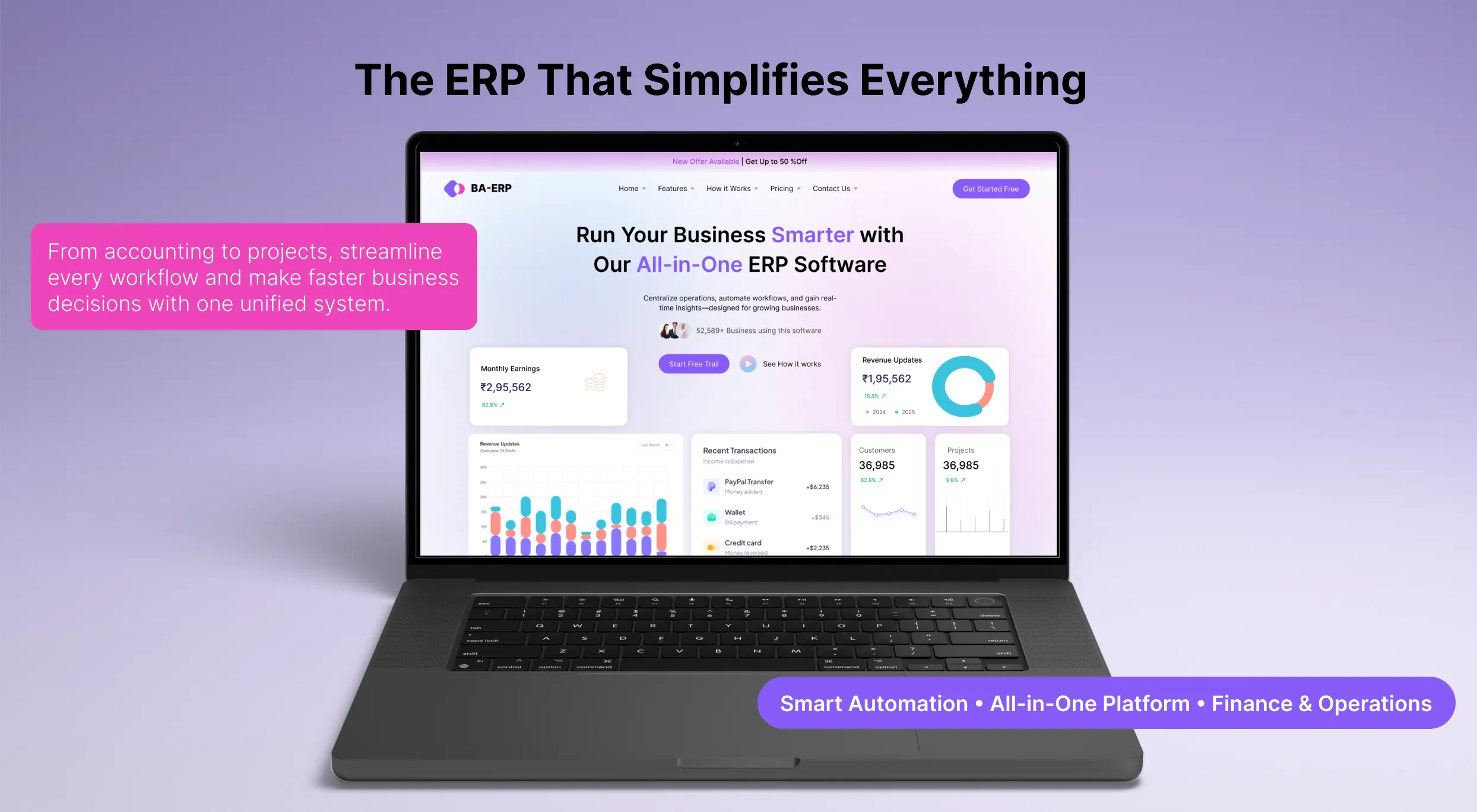
A highly modular Enterprise Resource Planning (ERP) suite designed to consolidate fragmented finance, HR, and procurement workflows into a unified data architecture.
Enterprise Software
Cloud ERP

What frustrates enterprises most and how we solve it with precision engineering
A detailed look at the approach, delivery decisions, and execution details.
As Small and Medium Enterprises (SMEs) scale, they inevitably hit an operational wall. Functions that were once managed by a single person in Excel (finance, payroll, procurement) fracture into departmental silos. Without a centralized nervous system, data visibility across the organization plummets, resulting in duplicate data entry, massive reconciliation delays at month-end, and a total inability for executives to track real-time operational metrics. Purchasing an Oracle or SAP license is cost-prohibitive and massively over-complicated for this segment.
Brihat engineered BaERP to provide enterprise-grade operational consolidation specifically optimized for the SME scaling phase. We built a modular architecture allowing businesses to adopt core modules progressively, eliminating the heavy disruption of a traditional ERP rollout.
At the core of BaERP is an automated financial ledger.
We engineered features that include:
We eliminated the HR silos by building robust payroll models that inherently calculate regional tax liabilities and track time-and-attendance natively within the broader operational database. To ensure this data was actionable, Brihat engineered advanced Analytics Dashboards. Instead of waiting weeks for reporting, executives access real-time, department-level KPI visualizations, allowing them to govern the expanding enterprise with absolute structural clarity.

This system was delivered through a structured, governance-first approach designed for enterprise environments — balancing speed with stability, and innovation with accountability.
Deep analysis of existing systems, workflows, data ownership, and decision paths to define clear system boundaries and risks.
Designed a modular architecture with role-based access, auditability, and security controls embedded from day one.
Delivered in controlled iterations with continuous validation against real workflows, data integrity, and operational needs.
A phase-by-phase view of operational change, business outcomes, and measurable progress after implementation.
Achieved absolute cross-referential data integrity.
Brought total control to corporate expenditures automatically.
Shifted management from reactive problem solving to proactive strategy.
Measurable results demonstrating how intelligent systems replaced legacy processes with speed, accuracy, and accountability.
Software Silos Eliminated
Duplicate Data Entry (-%)
Data Consistency (%)
Staff manually copied data between accounting software and HR sheets.
Engineered a singular unified database architecture.