
Generative Design in Industrial Art
How AI and algorithms are helping engineers and furniture designers create structures that look organic and bone-like.
Brihat Team
Posted on Apr 03, 2026
Generative Design in Industrial Art: When Algorithms Start Thinking Like Nature
What if design didn’t begin with a sketch — but with a system?
Introduction
Generative design is changing the way engineers and designers create. Instead of manually crafting forms, they define constraints: material limits, weight targets, stress conditions.
The algorithm then explores thousands — sometimes millions — of possibilities to find the most efficient solution.
The result?
Structures that look less like something built — and more like something grown.
Organic. Bone-like. Alive.
What Is Generative Design?
At its core, generative design is a collaboration between human intention and machine exploration.
Designers input:
- Load requirements
- Material constraints
- Manufacturing methods
- Performance goals
The algorithm then:
- Simulates countless variations
- Tests each against real-world conditions
- Evolves the best-performing solutions
Why this is powerful
Instead of designing one solution, you get a spectrum of optimal possibilities — each tested, refined, and performance-driven.
Why Do These Designs Look Organic?
Because nature has already solved these problems.
When algorithms optimize for strength, efficiency, and minimal material usage, they often arrive at solutions evolution discovered over millions of years.
Nature’s Influence
- Bone Structures (Trabeculae)
Bones are porous lattices that place material only where stress exists. - Tree Branching
Efficient distribution of weight and nutrients using mathematical patterns. - Honeycomb Geometry
Maximum strength with minimal material. - Shell Structures
Curved forms that distribute stress evenly. - Coral & Minimal Surfaces
Growth patterns that optimize strength and surface area.
These are not aesthetic choices.
They are mathematical inevitabilities.
How the Process Works
Step-by-step breakdown
1. Define Constraints
Set goals — weight, strength, materials, and manufacturing limits.
2. Algorithmic Exploration
Generate thousands of variations simultaneously.
3. Evolution & Selection
High-performing designs survive.
4. Simulation
Stress testing using real-world physics models.
5. Production
Often built using 3D printing for complex geometries.
Material Matters: Form Follows Physics
One of the most fascinating aspects of generative design is how materials influence form.
Change the material — and the design changes completely.
- Titanium
Ultra-light, high-strength lattice structures. - Aluminium
Flexible and slightly thicker forms. - Biopolymers
Denser, coral-like structures due to lower strength. - Carbon Fiber
Minimal, skeletal structures with high stiffness.
The algorithm doesn’t just design shapes — it adapts to physics.
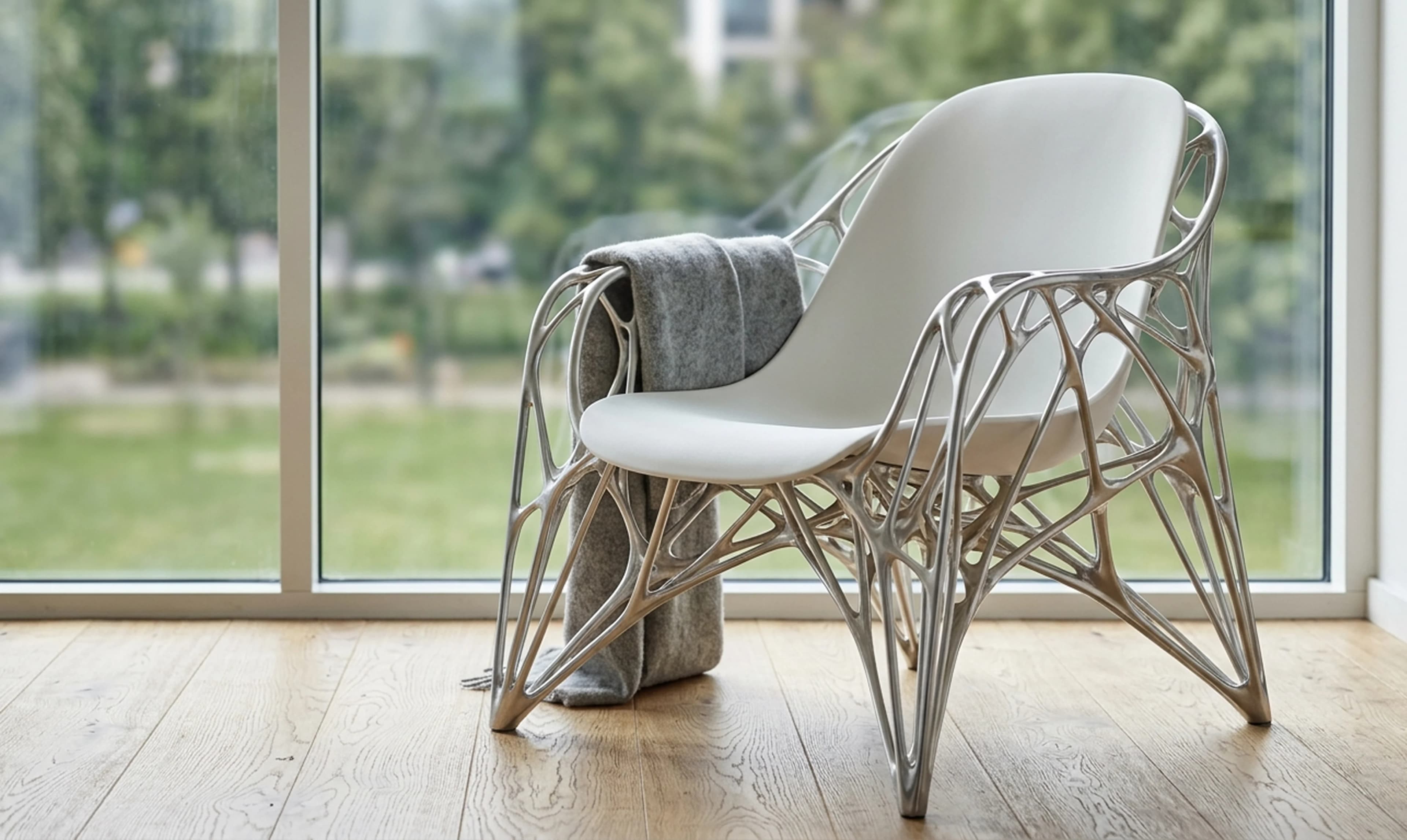
From Code to Craft: Generative Furniture
Generative design is not limited to engineering — it’s transforming art and furniture.
Designers are now creating pieces that:
- Mimic root systems
- Grow like branches
- Form lattice-like skeletons
What makes these pieces unique
- Structurally optimized
- Material-efficient
- Visually one-of-a-kind
These are not drawn forms.
They are grown through computation.
Real-World Applications
- ✈️ Aerospace — Up to 60% weight reduction
- 🦴 Medical — Better bone integration
- 🪑 Furniture — Sculptural + functional
- 🏗️ Architecture — Efficient structures
- 🚗 Automotive — Fewer parts, better performance
- 👟 Wearables — Personalized design
Why It Matters
From designing objects
to designing systems
From control
to collaboration
From intuition
to data-driven evolution
The Future: Designed or Grown?
The role of the designer is evolving.
You are no longer just shaping form.
You are shaping:
- Rules
- Constraints
- Possibilities
The machine explores.
You guide intention.
Conclusion
Generative design is not just a tool.
It is a new design philosophy.
- Efficiency creates beauty
- Constraints drive creativity
- Forms feel grown, not built
The most powerful designs of the future won’t be drawn.
They will be grown by intelligence.