

Cultural Symbolism in Pattern Design
The Sacred Geometry of the Buta and the Block—A History of Indian Motif in Modern Identity
Brihat Team
Posted on Apr 02, 2026
The Sacred Geometry of the Buta and the Block: A History of Indian Motif in Modern Identity
Two ancient patterns — one a teardrop of cosmic meaning, one an inked wooden block pressed with devotion — have travelled centuries to arrive in your wallpaper, your fashion, and your sense of self.
Introduction
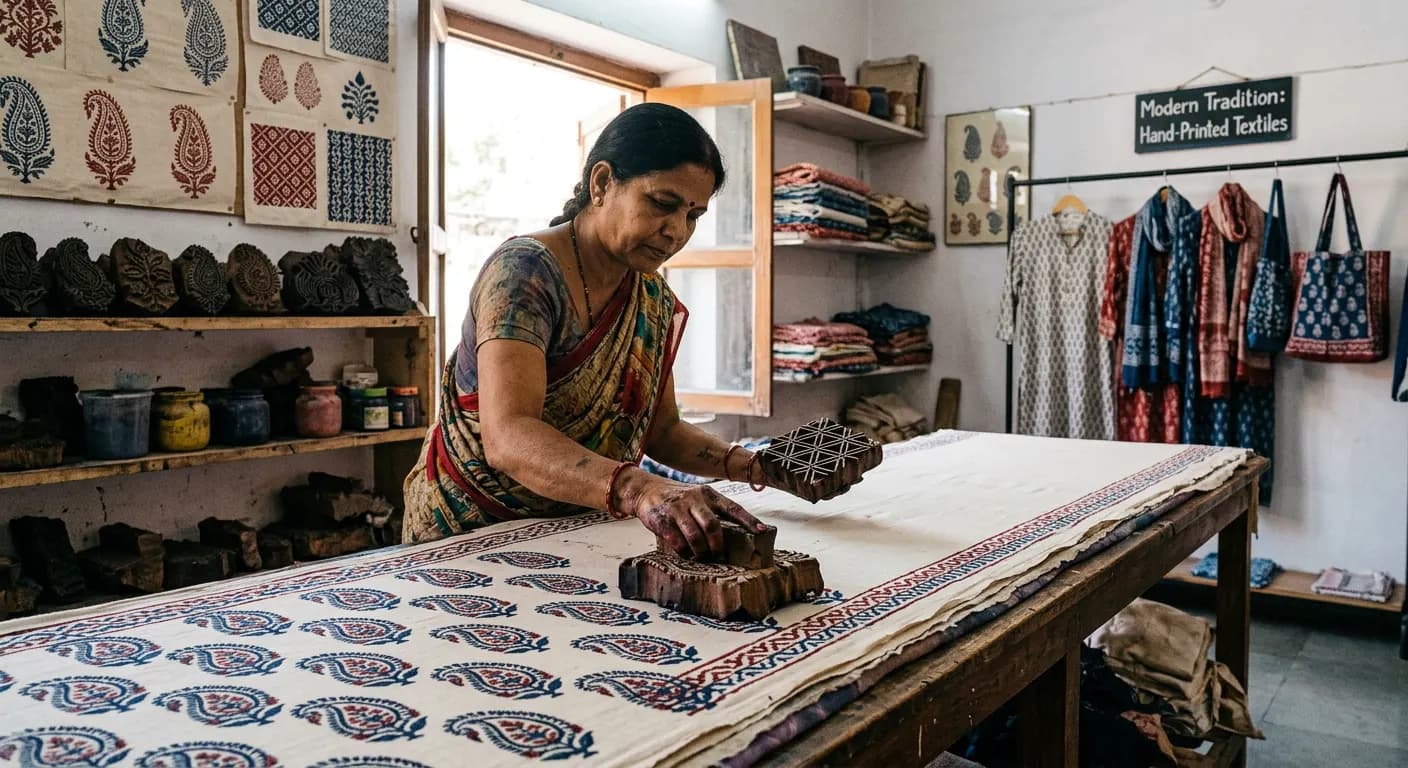
Every culture leaves marks on cloth. India left the Buta — a curved, weighted teardrop that Western eyes would call a paisley — and the Block print, a sacred act of repetition where carved wood meets dyed cloth in rhythms as deliberate as prayer.
Together, these two forms constitute one of the world's most sophisticated visual languages, one that has never stopped speaking.
What makes them remarkable is not their beauty alone. It is the structural intelligence beneath them: the geometry that has made them legible across continents, adaptable across centuries, and still capable of carrying meaning today.
Understanding the Buta
The Buta — known in the West as the paisley — is one of the oldest continuously used design motifs in human history. Its teardrop form has been interpreted as a mango, a cypress tree bent in wind, a divine flame, or even the cycle of life itself.
That ambiguity is the point.
The curve of the Buta’s tip is not decorative. It is a deliberate deviation — a symbolic “lean” that reflects deeper philosophical ideas. Every part of the form carries weight that its geometry was designed to hold.
“The Buta contains within it a philosophy of abundance: the form that curves toward itself, returning to its own origin, as water returns to the sea.”
— Lotika Varadarajan, Traditions of Textile Printing in Kutch
The Block Print: A Legacy of Craftsmanship
The Block print is a technology of devotion. A craftsman spends years mastering carved wooden blocks, understanding pressure, rhythm, and dye.
The result is not just printed fabric — it is marked with intention.
Rajasthan and Gujarat remain centers of this tradition, producing patterns that translate nature into geometry — flowers into forms, rivers into repetition.
What makes block printing special is its imperfection. Each print varies slightly. This is not a flaw — it is the signature of the hand.
A Living History: From Court to Catwalk
The journey of the Buta and the Block is one of constant evolution.
- Indus Valley (c. 2500 BCE): Early symbolic forms
- Mughal Era: Royal textiles and Kashmiri shawls
- Colonial Period: Industrialisation in Scotland
- 1960s–70s: Counterculture revival
- Today: Modern identity and design language
A motif that survives a thousand years does not do so by staying the same — but by carrying meaning across generations.
The Symbols and Their Meanings
Indian textile motifs form a deeper visual language:
- Buta / Paisley: Fertility, abundance
- Lotus: Purity and enlightenment
- Mango: Prosperity
- Peacock: Beauty and royalty
- Chakra: Time and cosmic order
- Creeper: Growth and connection
To understand these patterns is to read a language — one that encodes philosophy into form.
The Intersection of Tradition and Modernity
Designers return to these patterns not out of nostalgia, but because they still work — structurally and visually.
The Buta’s asymmetry creates movement. Block printing adds depth through variation.
What evolves is not the form, but the colour — adapting tradition to the present.
Embracing Cultural Heritage
In a fast, trend-driven world, these motifs offer something rare: depth you can trace.
When you understand their meaning, you don’t just see design — you experience history.
These motifs have always travelled. What matters is that they carry awareness with them.
How meaning is encoded in form, transmitted through repetition, and felt even when not fully understood.
Conclusion
Patterns travel. Meaning evolves. But the most powerful designs endure.
The Buta and the Block are not just visual elements — they are living systems of meaning.
And in a modern world searching for identity, that makes them more relevant than ever.