
AI as a Creative Partner, Not a Replacement
AI to Brainstorm Mascot Variations and Mood Boards In the design world it is really important to use technology to help with work.
Brihat Team
Posted on Apr 02, 2026
Here’s a clean, well-structured blog content version, ready for publishing or portfolio use.
AI as a Creative Partner, Not a Replacement
My Workflow for Mascot Brainstorming & Mood Boards
I’ve been using generative AI in my design process for over a year now. Here’s exactly what I do — and more importantly, where I step back in and make it mine.
The Moment Everything Changed
Let me tell you about the moment I stopped being scared of AI tools.
I was stuck on a mascot brief for three days. I had filled pages of my sketchbook with versions of the same character and kept landing in the same aesthetic corner.
On a whim, I typed a rough description into an AI generator. Within seconds, I saw directions I hadn’t even considered.
I didn’t use any of them directly.
But I used the ideas inside them.
That’s what people misunderstand about generative AI — the outputs aren’t the deliverable. They’re the conversation starter.
Since then, I’ve built a repeatable six-step process that puts AI in the right seat — shotgun, not behind the wheel.
Step 1 — Define Your Concept
Before opening any AI tool, I spend real time on the brief.
Not just category-level thinking — actual emotional clarity.
A mascot for a sports team could be:
- Tough and aggressive
- Friendly and community-driven
Both are valid. But they are completely different directions.
My brief always answers:
- What should users feel in the first second?
- What should they remember a week later?
- What should this never look like?
Negative constraints sharpen creative direction.
Step 2 — Gather Inspiration First
Before generating anything, I collect references.
Pinterest, Behance, books, screenshots — anything that resonates.
I don’t just collect images. I label why I saved them.
For example:
- “Strong posture”
- “Bold color blocking”
- “Friendly expression”
This builds your visual vocabulary.
And later, your prompts become sharper:
- ❌ “retro style”
- ✅ “1960s vintage sports illustration with bold outlines”
Specificity is everything.
Step 3 — Prompt with Intention
Most people write prompts like search queries. That’s the mistake.
A good prompt reads like a creative brief.
It should include:
- Subject
- Personality
- Style
- Color palette
- Constraints
Example
A mascot character — a playful octopus — with a warm, community-focused personality. Hand-drawn ink illustration style, soft pastel palette, expressive and friendly forms, suitable for digital and print.
The difference between average and great output is almost always the prompt.
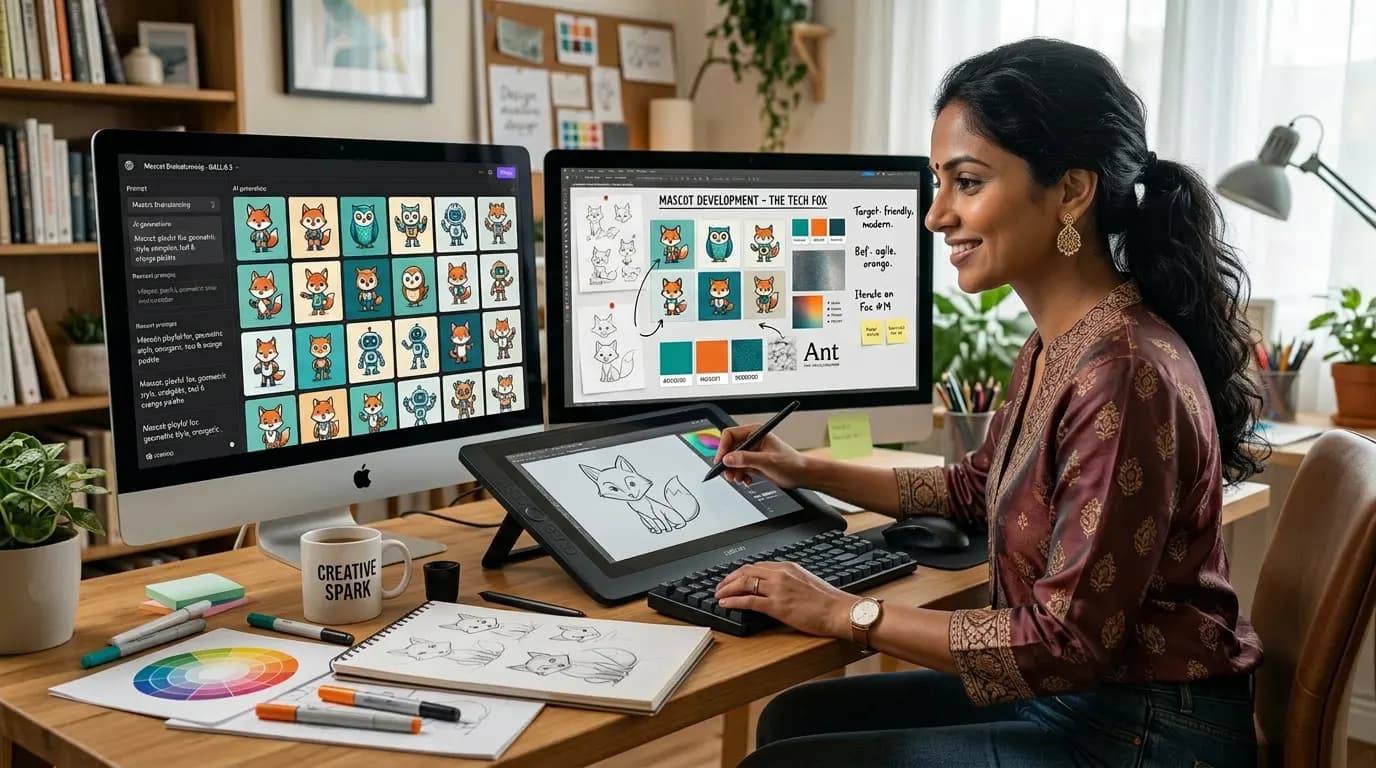
Step 4 — Generate Many, Curate Few
This is where discipline matters.
- 4–6 variations per prompt
- Across 2–3 directions
Don’t judge while generating.
When reviewing, I look for:
- Posture
- Color combinations
- Facial expressions
The first generation is not the result.
It’s the first sentence of a conversation.
Then refine and repeat.
Step 5 — Build the Mood Board
Once I shortlist 3–5 directions, I build a mood board.
- AI outputs
- References
- Typography
- Color palettes
Make the direction visible.
A crowded mood board is a confused brief.
Clarity over quantity.
Step 6 — Add the Human Touch
This is where the real design happens.
- Print it
- Sketch over it
- Modify proportions
- Refine expressions
- Adjust colors
The final output is never straight from AI.
It’s interpreted, refined, and owned.
AI vs Human — The Real Partnership
What AI Does Well
- Generates variations instantly
- Explores unexpected ideas
- No fear of bad ideas
- Endless iteration
What You Bring
- Understanding of the brief
- Taste and judgment
- Cultural awareness
- Craftsmanship
- Responsibility
AI expands possibility. You define meaning.
My Honest Take
The designers struggling with AI are waiting for it to do their job. It won’t.
The ones thriving use it as:
a fast, slightly chaotic creative partner.
You still need strong thinking, taste, and craft.
Final Thought
- Start with a real brief
- Gather references
- Generate in volume
- Curate ruthlessly
- Build a clear mood board
- Add your human craft
You’ll reach better ideas faster —
and they’ll still feel like yours.